
Purifying the Heart-Mind with Waka

Instructor
Brian Brunius
Reviews
Course Overview
INTRODUCTION — READ BEFORE BEGINNING
Welcome
This course restores a quiet but central aspect of Usui-era Reiki practice: the purification of the heart-mind (kokoro) through disciplined contemplation.
Mikao Usui emphasized seishin shūyō, spiritual cultivation, as foundational to healing work. Reiki was never meant to be practiced as a technique alone. Before methods, before outcomes, practitioners were asked to refine the inner condition through which Reiki is expressed.
One of Usui’s primary tools for this refinement was the contemplation of waka—short poems (gyosei) written by Emperor Meiji. These poems were not used for study or interpretation. They were used as mirrors: concise forms of language that quietly reveal agitation, bias, haste, and ethical misalignment without instruction or commentary.
This course adapts that practice for modern life.
A Note on Kokoro (Heart-Mind)
In English, we tend to separate thinking and feeling. We speak of thoughts as belonging to the head and emotions as belonging to the heart.
Japanese culture does not make this split in the same way.
The word kokoro refers to the orientation from which thinking, feeling, intention, and conduct arise together. It is not an emotion and not a stream of thoughts. It is the underlying condition that shapes tone, timing, restraint, and response.
In this course, you are not asked to understand kokoro conceptually or to locate it anatomically. If you try to figure it out, you will miss it.
Instead, the practice gently shifts attention away from interpretation and toward direct presence. Over time, this change in orientation becomes recognizable through its effects: less reactivity, clearer intention, and a steadier quality of presence in both daily life and Reiki practice.
You do not need to understand kokoro in order to work with it. Let the practice teach you.
A Note on Emperor Meiji and the Waka
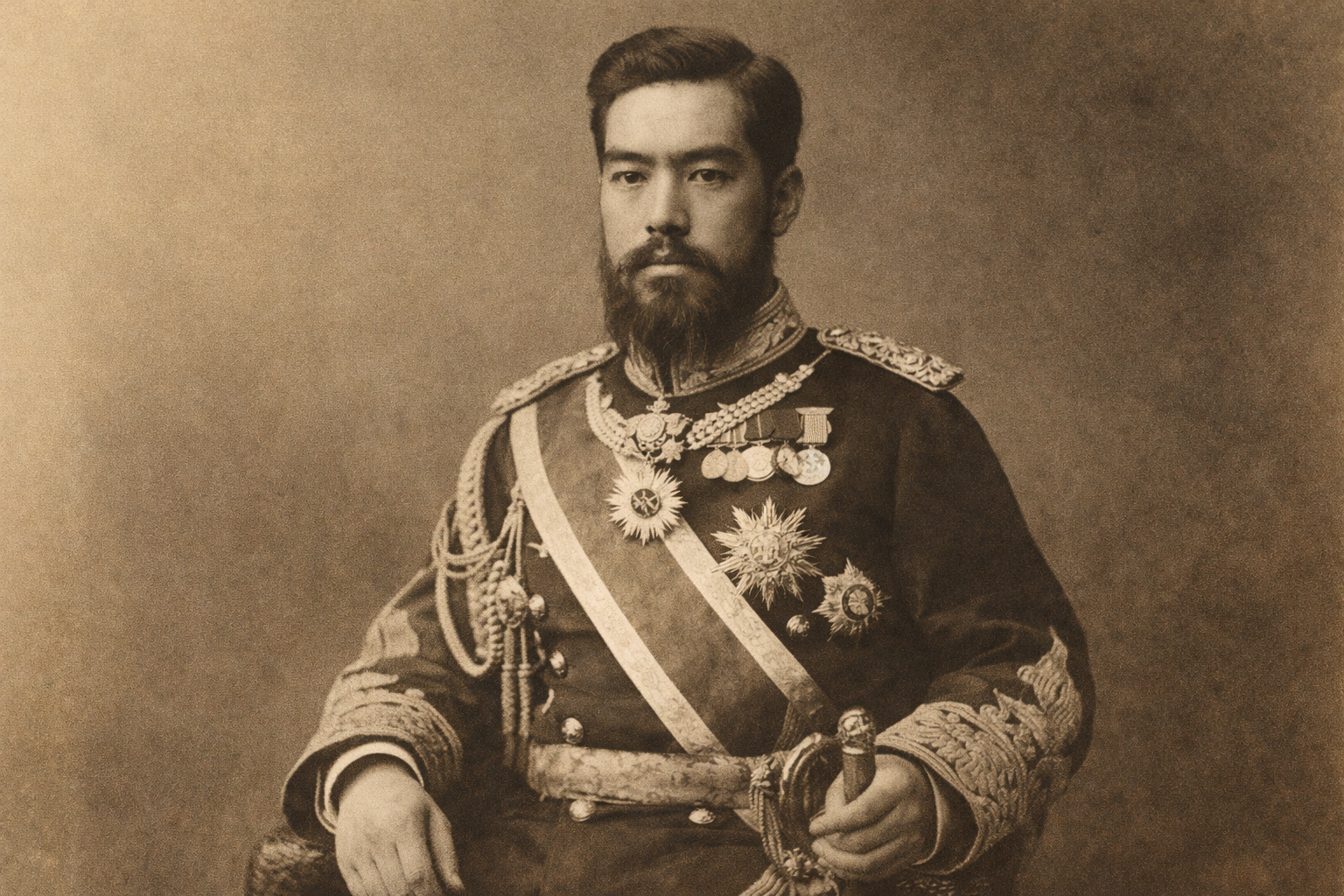
For over a thousand years, Japanese emperors have written poetry as part of cultural and moral life. When composed by an emperor, these poems are known as gyosei.
Emperor Meiji (1852–1912), the 122nd emperor of Japan, lived during a period of immense transformation as Japan entered the modern era. He composed tens of thousands of waka over his lifetime. During his own time, his poetry was widely respected for its moral clarity, restraint, and spiritual seriousness.
These poems were not written as literary achievements. They were expressions of ethical orientation and everyday sincerity, addressing themes such as nature, responsibility, humility, effort, and right conduct.
Mikao Usui selected a group of Emperor Meiji’s waka for use in Reiki training because of their capacity to refine attention and heart‑mind (kokoro) without instruction or explanation. They were used as contemplative tools, not as objects of belief or devotion.
Emperor Meiji and his consort Empress Shōken are enshrined at Meiji Jingu in Tokyo. Today, visitors still encounter waka there as part of ordinary shrine practice.
In this course, the poems are approached in the same spirit: as practical mirrors for inner cultivation, not as historical artifacts or objects of reverence.
What This Course Is — and Is Not
This is not a poetry course. This is not a cultural history class. This is not a promise of special experiences.
It is a daily contemplative discipline for Reiki practitioners who wish to cultivate steadiness, clarity, and right-mindedness at the level Usui originally emphasized.
How the Practice Works
Each day you will work with a single waka using the same structure:
- Sit upright
- Hands in gasshō
- Three slow breaths into the hara
- Read the waka aloud once
- Read it silently once
- Sit without interpretation or reflection for 3–5 minutes, using one of the silent contemplation audios below
If the mind wanders, return to the feeling of sitting. If nothing happens, that is still the practice.
Optional extension: repeat the full cycle once, or remain seated an additional 5–10 minutes, or use the longer contemplation audio.
Why Purify the Heart-Mind?
In Reiki, healing does not arise from effort or intention alone. It arises through presence. When kokoro is agitated, practice becomes strained and performative. When kokoro is settled, Reiki becomes simple, responsive, and reliable.
Purifying the heart-mind does not mean becoming morally perfect. It means becoming clearer, less reactive, and more aligned in how one meets life and practice.
What Success Looks Like
Progress in this course often appears quietly:
- less urgency to interpret or explain
- quicker return to steadiness
- simpler self-treatment
- more ease in hands-on work
There is nothing to achieve here. Only something to notice.
